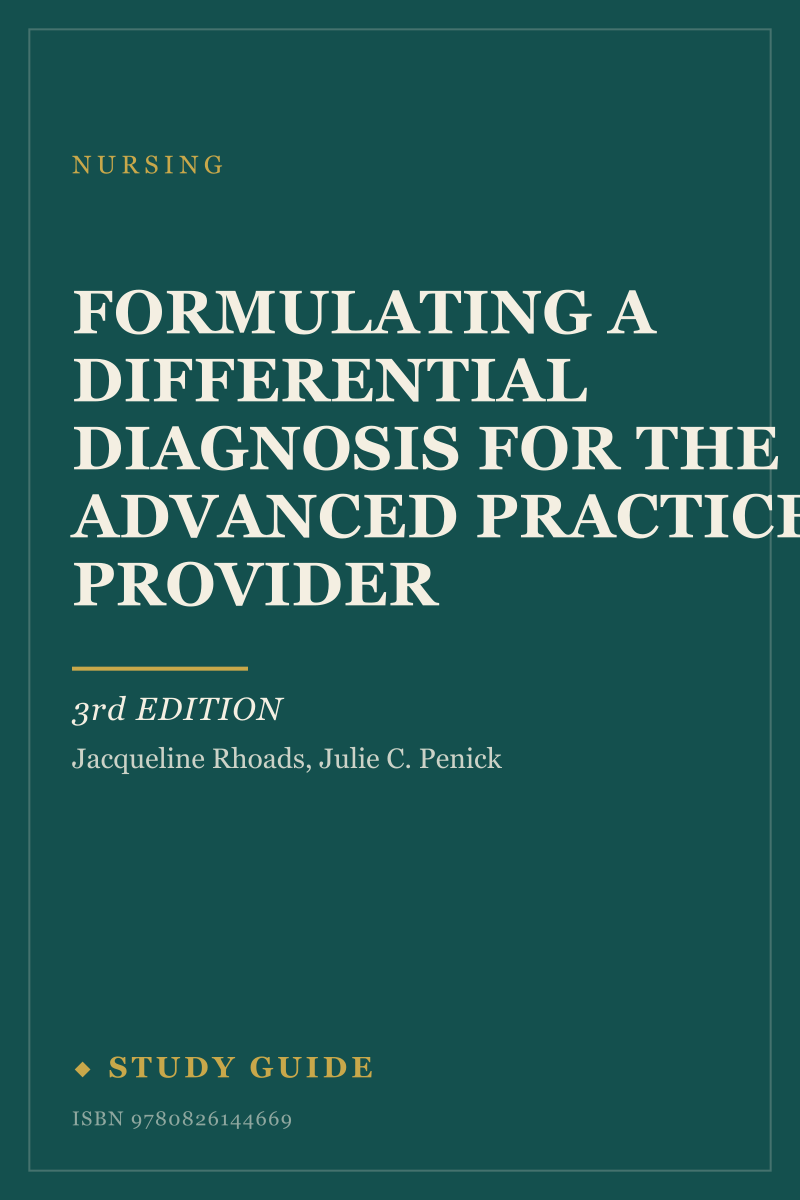
Formulating a Differential Diagnosis for the Advanced Practice Provider
Jacqueline Rhoads, Julie C. Penick · 3rd Edition
Complete chapter-by-chapter study guide aligned with Formulating a Differential Diagnosis for the Advanced Practice Provider (3rd Edition). Includes summaries, learning objectives, and NCLEX-style practice questions for all 78 chapters.
Overview
Rhoads and Penick's Formulating a Differential Diagnosis for the Advanced Practice Provider (3rd Edition) teaches the diagnostic reasoning process that nurse practitioners and physician assistants rely on, organized around common presenting complaints rather than diseases. After an introduction to differential diagnosis and the diagnosis of common problems, the book works symptom by symptom — from blurred vision, congestion, headache, and fever, through coughing up blood, shortness of breath, chest pain, dizziness, and palpitations, to abdominal pain, dysphagia, rectal bleeding, painful urination, flank pain, and many more — guiding the reader to build and narrow a differential from the patient's presentation. This study guide is built to match the textbook chapter for chapter, so you review in the same order your course teaches and can practice the structured reasoning that moves from symptom to likely diagnoses. It is an independent, aligned study guide — not the textbook and not a copy of it — focused on the high-yield differentials and clinical reasoning so you can review efficiently for coursework and certification-relevant material.
Aligned with nurse practitioner and physician assistant courses in advanced health assessment and diagnostic reasoning, supporting clinical coursework and the symptom-based reasoning emphasized in NP and PA certification preparation.
- 2,340+ practice questions
- 78 chapters
- ~1320 pages
- Instant PDF download
What you'll learn
The major topics this guide walks you through, matched to the textbook's order:
- The differential diagnosis process
- HEENT complaints
- Headache and dizziness
- Fever and lymphadenopathy
- Cough and shortness of breath
- Chest pain and palpitations
- Bradycardia and syncope
- Abdominal pain and dysphagia
- Heartburn and nausea
- Rectal bleeding and pain
- Hematuria and dysuria
- Flank pain and incontinence
- Lower extremity edema
- Symptom-based clinical reasoning
Need the textbook itself?
By Jacqueline Rhoads and Julie C. Penick and published by Springer Publishing, Formulating a Differential Diagnosis for the Advanced Practice Provider is a popular symptom-based diagnostic reasoning text used by NP and PA students to learn how to build and narrow a differential.
Buy new, rent, or find a used copy of Formulating a Differential Diagnosis for the Advanced Practice Provider below. Make sure you get the 3rd Edition — editions differ, so double-check the ISBN on the listing before you order. We earn a small commission if you buy through these links — your price is unchanged.
Chapters covered
Every chapter below is fully covered in the PDF — summary, learning objectives, key terms, and NCLEX-style practice questions with rationales.
Thinking about RN-to-BSN or MSN?
Compare accredited online nursing programs (CCNE-accredited, NCLEX pass rate published) in under a minute. Most students get a tuition estimate the same day.
Compare nursing programsNew grad? You need your own malpractice policy.
Your employer's coverage doesn't fully protect you. A personal RN policy from NSO runs about $100/year and is what most nursing boards recommend on day one.
Get a quote from NSOQuestions about this study guide
What exactly do I get?
A printable PDF study guide covering all 78 chapters of Formulating a Differential Diagnosis for the Advanced Practice Provider (3rd Edition) — chapter summaries, learning objectives, and NCLEX-style practice questions with rationales. One file, lifetime access, no subscription.
How soon will I get it?
Instantly. A download link appears on screen and lands in your inbox the moment your payment clears.
Does this match the 3rd Edition?
Yes. It is organized to align with the 3rd Edition and follows its symptom-by-symptom structure.
Is this organized by symptom or by disease?
By presenting symptom, just like the textbook. This mirrors how advanced practice providers actually reason from a patient's complaint to a differential.
Who should use this study guide?
It is built for nurse practitioner and physician assistant students learning diagnostic reasoning, focusing on the high-yield differentials and reasoning steps relevant to coursework and certification.
Will it match my edition?
This guide is built around the 3rd Edition. If your class uses a different edition, chapter numbering may shift slightly, but the topics and learning objectives are usually unchanged.
Do I still need the textbook?
The study guide is a companion, not a replacement — it helps you study efficiently and review fast, but you'll still want the textbook for full depth and any assigned readings. You can buy new, rent, or find a used copy through the price links on this page.
What if it is not what I expected?
Every purchase is backed by a 14-day money-back guarantee — email us within 14 days for a full refund.
Is this a test bank or copied from the textbook?
No. This is an original study guide written to align with Formulating a Differential Diagnosis for the Advanced Practice Provider — summaries, objectives, and practice questions with rationales, not a reproduced publisher test bank or copied text.
More nursing study guides

About this study guide
This is an original study guide written to align with the topics and learning objectives covered in Formulating a Differential Diagnosis for the Advanced Practice Provider (3rd Edition) by Jacqueline Rhoads, Julie C. Penick. It is not affiliated with, endorsed by, or licensed by the publisher or the textbook's authors. All summaries, practice questions, and explanations are independently authored.